L1 Immigration Attorney Advice
Within the complex landscape of global business, the capability to position skilled professionals to the right place at the right time provides a competitive edge. For multinational organizations, the L-1B visa functions as a professional's copyright-an essential tool for bringing professionals with unique skills to the United States. This visa category is specifically designed for individuals who possess "specialized knowledge" that is fundamental to the company's operations, products, or services. However, the term "specialized knowledge" represents one of the most challenging and thoroughly reviewed components in U.S. immigration law. This read more overview is intended to explain the L-1B visa, offering a clear pathway for companies and employees looking to leverage this strategic option. With the guidance of a seasoned L1 immigration attorney, the L-1B visa can open up new possibilities for development and progress in the American market.
Essential Points
- The L-1B visa is a temporary work permit for employees with L-1B specialized knowledge that is essential for a company's interests.
- It stands as a key element of the multinational company transfer system, allowing organizations to harness their internal talent pool for U.S. operations.
- Unlike the executive transfer visa (L-1A), the L-1B highlights an employee's specialized knowledge and capabilities instead of their executive functions.
- Demonstrating expert expertise is a demanding evidentiary bar, rendering the assistance of an L1 visa lawyer vital for preparing a successful submission.
- An experienced L1 immigration attorney is your best resource while managing the challenges of the L-1B application, particularly with responding to challenging Requests for Evidence (RFEs).
- While the L-1B comes with a five-year limit, it can act as a stepping stone to a copyright, and an immigration lawyer can assist planning for this future objective.
Navigating Global Business: The Essential Guide to Multinational Company Transfers
The L-1 visa program functions as the foundation of global business, facilitating the seamless movement of talent for a multinational company transfer. It permits businesses to relocate key personnel from their overseas locations to a subsidiary, affiliate, parent, or branch office in the United States. This corporate relocation process is vital for preserving corporate culture, transferring institutional knowledge, and carrying out global business strategies. The L-1 visa is separated into two distinct categories: the L-1A for executives and managers, and the L-1B for specialists with unique expertise. Though both categories support the broader goal of promoting international business, they possess different qualification requirements and strategic implications. Comprehending the intricacies of this program is crucial for any organization seeking to grow its footprint in the U.S., and it is a process best navigated with the guidance of an experienced immigration lawyer.
The Cornerstone of Your Application: Defining L-1B Advanced Knowledge
The foundation of the entire L-1B visa petition centers around a fundamental, critical, and sometimes elusive component: L-1B specialized knowledge. This definition is not straightforward, and its application by U.S. Citizenship and Immigration Services (USCIS) has developed over time. According to USCIS, specialized knowledge encompasses knowledge possessed by an individual that is advanced and unique to the petitioning organization's services, products, technologies, procedures, management, or other key elements. It represents knowledge that is not widely available within the industry or that isn't readily teachable to another individual without considerable investment or organizational disruption. Establishing the existence of specialized knowledge requires meeting a high evidentiary threshold. It requires a thorough and persuasive presentation that the employee's skills and expertise are truly unique, proprietary, and essential to the company's U.S. operations. This is where the expertise of an L1 visa lawyer is crucial in building a convincing and comprehensive case.
Navigating the L-1A Executive Transfer Visa Process
To thoroughly grasp the unique nature of the L-1B visa, it is helpful to compare it with its executive counterpart, the L-1A visa. The L-1A is an executive transfer visa intended for senior leadership personnel who will be directing the management of the organization or a significant component. The focus of the L-1A is on the individual's high-level managerial or executive duties and their authority to determine outcomes and guide the work of others. In contrast, the L-1B centers on the specialized nature of the individual's knowledge, irrespective of their position in the corporate hierarchy. While an L-1A beneficiary directs the team, the L-1B beneficiary is often the crucial technical expert or specialist on that team. Grasping this differentiation is vital for choosing the correct visa category and for building a successful petition, as the evidentiary requirements for each are substantially different.
Building the Unshakable Case: How an L1 Visa Lawyer Proves Expert Knowledge
Establishing the existence of L-1B specialized knowledge requires both creativity and precision, and it requires the expertise of a skilled L1 visa lawyer. A successful petition needs comprehensive evidence founded upon a foundation of detailed evidence and persuasive legal arguments. An experienced lawyer partners closely with the company and the employee to identify and articulate the specific knowledge that sets the employee apart. This demands a thorough analysis of the company's proprietary processes, technologies, and business practices. The lawyer assembles a wide range of evidence to support the claim, which may include proprietary documents, training manuals, project reports, and management endorsements. The aim is to present a convincing and detailed case for the USCIS adjudicator, showing that the worker's expertise is more than beneficial, but truly essential to the U.S. operation's success. This meticulous case-building is the distinguishing feature of a premier L1 immigration service.
The Blueprint for Success: The L-1B Application Process Step-by-Step
Managing the L-1B application process is similar to using a comprehensive roadmap for success. With the expertise of an L1 immigration attorney, the process can be separated into a series of manageable steps. It begins with a comprehensive eligibility assessment of both the company and the employee. This is continued with the careful development of the petition, which encompasses the assembling of all necessary documentation and the creation of the legal arguments. Once the petition is lodged with USCIS, there is a phase of adjudication, during which the government reviews the case. If USCIS needs additional information, they will release a Request for Evidence (RFE), which must be answered in a quick and detailed manner. Upon authorization of the petition, the employee can then apply for their L-1B visa at a U.S. consulate or embassy abroad. The final phase is the visa interview, after which the employee can travel to the U.S. and begin their assignment.
Your Advocate in a Complex System: The Role of an L1 Immigration Attorney
The United States immigration process constitutes a complicated and demanding administrative process. An L1 immigration attorney functions as your advisor, supporter, and protector throughout this process. Their role goes further than handling forms; they offer strategic direction and to anticipate and overcome potential obstacles. Throughout the entire process, from first evaluation to visa approval, a skilled lawyer will support you, guaranteeing your petition is presented most effectively. They will guide you through the detailed administrative rules, ready you for immigration officer review, and address any complications that emerge. When one error or oversight could result in expensive setbacks or application rejection, the value of a dedicated legal advocate cannot be overstated.
Navigating Challenges: RFEs and Denials
Getting a Request for Evidence (RFE) or a denial on an L-1B petition is often a considerable setback, but this isn't necessarily the end of the process. This marks a crucial moment where the expertise of an L1 immigration attorney is particularly vital. An skilled attorney will carefully review the RFE or denial notice to identify the government's position and to identify the particular areas of concern. They will then partner with you to develop a strategy for responding to the RFE or for contesting or refiling the case in the case of a denial. A carefully prepared RFE response or appeal needs not just additional evidence, but also a compelling legal argument that effectively responds to the government's concerns. With the appropriate legal strategy, it is generally feasible to overcome these obstacles and secure a positive outcome.
The Blanket L-1: A Streamlined Option for Eligible Companies
For large, established multinational corporations, the Blanket L-1 program delivers a streamlined and efficient option for moving employees to the United States. After obtaining an approved Blanket L petition, the company can move employees, including those with L-1B specialized knowledge, eliminating the need to file a separate application with USCIS for each employee. Rather, the employee can request their L-1B visa directly at a U.S. consulate or embassy abroad. This can significantly reduce administrative overhead and processing delays. To be eligible for the Blanket L program, a company must meet certain business size and activity requirements. An experienced L1 visa lawyer can guide a company on their qualification status for this program and can help with the preparation and filing of the Blanket L petition.
Life in America: Understanding L-1B Status Rights and Restrictions
Life in the United States on an L-1B visa features a specific set of rights and limitations. The fundamental right is the authorization to work and reside in the U.S. for the petitioning employer. L-1B visa holders are also able to bring their immediate family members with them on L-2 dependent visas. A key benefit is that L-2 spouses are able to apply for work authorization, permitting them to work for any employer in the U.S. However, there are also limitations. The L-1B visa has a limit of five years, and once this limit is reached, the individual must generally depart the U.S. for at least one year before they can be eligible for a new L or H visa. It is also essential to understand that the L-1B is a non-immigrant visa, and holders must maintain an intent to leave the U.S. upon the expiration of their status.
L-1B to copyright: A Specialist's Path to Permanent Residency
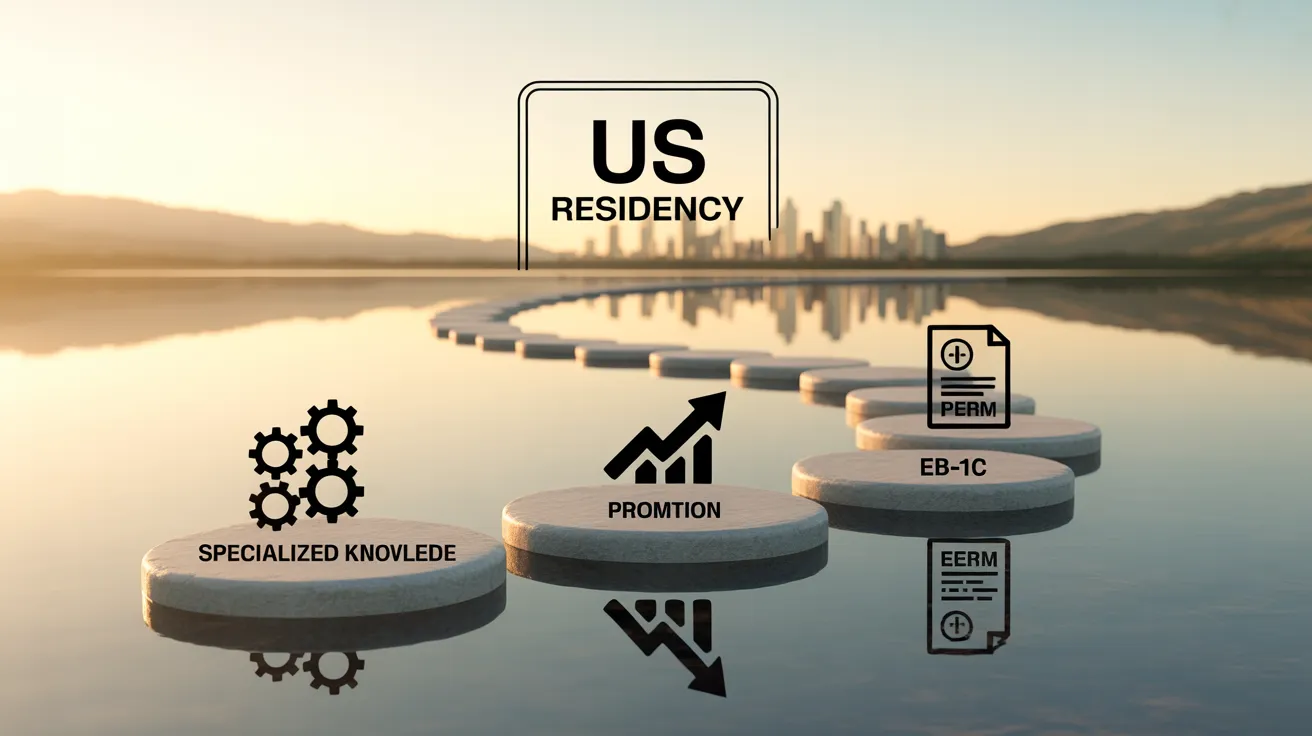
Although the L-1B visa functions as a temporary, non-immigrant visa, it can act as a useful stepping stone from specialist to resident. For numerous L-1B holders, the final target is to obtain permanent residency (a copyright) in the United States. Although the L-1B isn't equipped with a direct path to a copyright comparable to the executive transfer visa (L-1A) offers, there are still feasible pathways. An L-1B holder might qualify for a copyright through the PERM labor certification process, where their employer backs them for permanent residency. Otherwise, if the L-1B holder is promoted to a managerial or executive position, they could become eligible to apply for a copyright under the EB-1C category. An experienced L1 immigration attorney delivers crucial strategic guidance on the most suitable pathway to a copyright based on the individual's distinct circumstances and career trajectory.
Common Questions
What is the legal definition of L-1B specialized knowledge?
The legal definition of L-1B specialized knowledge is complicated and requires interpretation by USCIS. USCIS characterizes this as knowledge that is specialized and unique to the petitioning organization's operations, processes, methodologies, technologies, management approaches, or business interests. This knowledge must be distinct from what is generally known within the industry and that cannot be easily transferred to another individual without considerable resources or time investment. Proving that an employee's knowledge meets this high standard demands comprehensive evidence and a comprehensive demonstration of why their skills are unique and essential to the company. An L1 visa lawyer is vital for constructing a case that effectively demonstrates this.
What are the key differences between L-1B and H-1B visas?
Both the L-1B and H-1B serve as non-immigrant work authorizations, but they differ in several crucial aspects. The L-1B visa is specifically for intracompany transfers, requiring the employee to have been employed with a related foreign entity for a minimum of 12 months before coming to the U.S. The H-1B visa caters to individuals in specialty occupations and doesn't require prior employment with a related foreign company. The H-1B uses a lottery system due to annual numerical limits, but the L-1B has no annual cap. The L-1B requires specialized knowledge specific to the company, whereas the H-1B requires a bachelor's degree or its equivalent in a specific field.
Am I allowed to transfer to a different employer on an L-1B visa?
The L-1B visa is tied to a specific employer. Your work authorization is limited to the company that filed your L-1B petition. Should you want to switch companies, your prospective employer must submit a new visa petition for you, like an H-1B or other suitable visa classification. You cannot simply transfer your L-1B status to a new, unrelated company. This represents a significant distinction from other visa categories and is crucial for L-1B visa holders to understand.
What occurs when an L-1B petition gets denied?
When your L-1B petition receives a denial, your L1 immigration attorney will analyze in detail the denial notice to understand the reasons for the decision. According to the circumstances, you could explore several options. You might be eligible to file a motion to reopen or reconsider the case if you conclude there was a legal error in the decision. Otherwise, you can file an appeal with the Administrative Appeals Office (AAO). Sometimes, the best strategy could be to refile the petition with supplementary documentation that resolves the issues raised in the denial. An skilled attorney can guide you choose the most appropriate strategy.
Is it possible to transition from an L-1B copyright a copyright?
It's true, it is possible to secure a copyright while on an L-1B visa, though there is no direct path. The typical pathway is through employer sponsorship via the PERM labor certification process. This necessitates the employer showing that there are no qualified U.S. workers qualified for the position. Another potential pathway is in cases where the L-1B employee advances to a managerial or executive position within the company. In this case, they may become eligible to pursue a copyright under the EB-1C category for multinational managers and executives, which doesn't need a labor certification. A knowledgeable L1 visa lawyer can offer direction on the best long-term immigration plan.